

London Institute of Space Policy and Law
ispl
  • Home
  • Programs and Events
  • Research and Publications
  • Resources
  • People
  • Students
  • Contact

All News

Space Law and Policy Course (CPD) Open for Enrolment

Tuesday, April 8th, 2014

ISPL is pleased to announce that enrolment is now open for the 2014 Space Law and Policy Course.

Prospectus

The Course will comprise lectures and interactive case studies. Participants will have access to the IALS Law Library during the course. Those considering a post-graduate degree at ISPL will also be able to informally discuss their interest with the Director.

The Course will provide an introduction to:

• The space environment and space technology

• Orbits, their characteristics and management, and types of spacecraft

• Spectrum management

• The law governing space activities: principles & sources of space law, including conventions and treaties, national law and policies

• Comparison between space law and other legal regimes: Antarctic, maritime and air law

• Peaceful use of space, military activities & arms control

• Sovereignty

• Property rights

• Risk, liability and insurance

• The law as relates to specific applications: telecommunications and broadcasting, remote sensing, scientific experiment and exploration, manned activities including the International Space Station, unmanned activities

• Space policy and the institutions that implement them


The Course will be of interest to policy-makers, legal professionals, space sector executives and engineers, officials of government and international bodies, academics and post-graduate degree candidates.

The course is designed to be accessible to those in legal, technical or business training or employment. Previous knowledge of law or policy is not required. It will be particularly appropriate for those working in the space sector who wish to increase their knowledge of the current legal and policy framework, in order to take full advantage of the available opportunities and to create new ones.

The Course will be valuable for a variety of individuals.


• Satellite manufacturing or operation team members seeking an understanding of legal issues relating to design, manufacture or provision of space products and services

• Law, business and technology post-graduate students interested in the field

• Insurers and executives who want the tools to evaluate legal aspects of risk and liability

• Managers and team leaders of space operations who wish to better understand the legal and policy issues they encounter, and to be able to plan more proactively

• IGO and space agency team members concerned with national and international issues arising from activities in space, such as earth observation, and their regulation

• Lawyers and jurists whose practice brings them into contact with space law through legal evidence from satellites, contractual matters or international commerce


Note: Undergraduates please register for our short course in space law later this year.

CPD

The course qualifies for 15 hours CPD for Solicitors (SRA) and for Barristers (to be confirmed). Other professionals: please contact your respective professional bodies about whether the course will qualify for CPD.
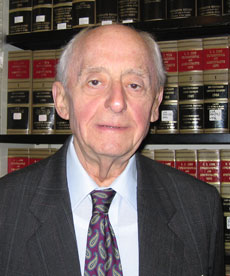


In Memory of Professor Vladimír Kopal

Monday, February 10th, 2014

We are sad to report that Professor Vladimír Kopal passed away on 27 January 2014 at the age of 85.

kopal

He was Professor of International Law at the West Bohemian University in Pilsen, Czech Republic, he was Chairman of the Legal Subcommittee of the Committee on the Peaceful Uses of Outer Space. A brief biography can be found on the UN Office of Legal Affairs website.

Tanja Masson-Zwaan, President of IISL and ISPL Faculty member, writes, “Prof. Kopal was a co-founder and one of the pillars of the IISL, always deeply involved with our work, and also served many decades as legal counsel of our sister organisations, the International Astronautical Federation (IAF) and the International Academy of Astronautics (IAA).

He was a pioneer of space law, and had an impressive career both in academics and in the UN, serving for many years as delegate of his country, as head of the Office for Outer Space Affairs, and twice as Chairman of the Legal Subcommittee of UNCOPUOS. 

Perhaps above all, he was an excellent teacher to students all over the world, and a true friend to many of us. 

 His death is a loss to the entire space community, and he will be missed by us all.”

 Professor Mosteshar, ISPL Director, adds, “He was one of the most courteous and interesting members of the community. His contributions to the field were many, and he always found time to speak with students and those new to the field.”

Professor Kopal’s funeral will take place on February 11th. An obituary has been posted on the IISL website. You may also send an email message to memoriam@iislweb.org. Messages will be added to an online register of condolences.


Astronomy Photographer of the Year 2013

Sunday, December 15th, 2013


The winners have been announced in the Royal Observatory’s astronomy photography competition. More than 1200 photographs of stars, planets, galaxies and other celestial highlights were submitted through Sky at Night Magazine and Flickr.

indonesia_amo_2013336_lrg

The Winners

 The overall winner, and the winner of the Earth and Space category, was Mark Gee of Australia, with “Guiding Light to the Stars”.

The Deep Space category winner was Adam Block of the USA, with “Celestial Impasto: sh2-239”.

The winner of the category Our Solar System with “Corona Composite of 2012” is Man-To Hui of China.

Three special prizes are also awarded.  Mark Gee was the winner of the People and Space category, with “Moon Silhouettes”.  László Francsics of Hungary won the Robotic Scope category, with “The Trapezium Cluster and surrounding Nabulae”.  The ‘Best Newcomer’ prize, renamed this year “The Sir Patrick Moore Prize for Best Newcomer’ in honour of this well-known broadcaster, lunar observer and former judge of the competition, is Sam Cornwell of the UK, with “Venus Transit, Foxhunter’s Grave, Welsh Highlands”.

The photographs can be seen on the Royal Observatory website.

Exhibition, Book and App

An exhibition of the photographs runs until 23 February 2014, and a hardback book is available, with the shortlisted and winning entries.  There is also an app for iPhone and iPad, with 90 images and technical information about them. 


Image information:

Cloud Towers above is not one of the exhibition images.  It is a NASA image.

In a view from high altitude, height can be a difficult thing to gauge. The highest of clouds can appear to sit on a flat plane, as if they were at the same elevation as the ocean or land surface. In this image, however, texture, shape and shadows lend definition to mushrooming thunderheads over the Indonesian island of Flores. The Moderate Resolution Imaging Spectroradiometer (MODIS) on NASA’s Aqua satellite acquired this image on the afternoon of Dec. 2, 2013.

The towering clouds are so well defined that it is easy to visualize the rapidly rising air that is fueling them. “This looks like a classic example of island convection that is enhanced by topography,” says NASA scientist Joseph Munchak.

During the day, sunlight heats the land more quickly than it heats the ocean. The warm air over land rises, creating an area of low pressure that pulls in cool air from the ocean. The result is a sea breeze. On this Indonesia island, the sea breeze from the Flores Sea on the north blows inland and clashes with the sea breeze blowing inland from the Savu Sea in the south. When the two breezes meet in the center of Flores, they push the air up. The rising air cools and condenses into a line of clouds.

Sea breeze convection is not the only force at work here. On Flores, cloud formation has help from the shape of the land. A line of tall volcanoes runs down the spine of the island, and their steep slopes also force air to rise. So, moist ocean air blows inland, hits the mountains and volcanoes and rises with the slope. Above the mountains, the rising air meets the rising sea breeze from the other side, and the upward motion is reinforced.

The combination of the two forces pushes air high into the atmosphere, resulting in large towering clouds of the sort that usually produce thunderstorms. In fact, a weather station on Flores reported rain and thunderstorms on December 2. This type of convection is strongest in the early afternoon, says Munchak, just about the time when Aqua MODIS acquired the image. The clouds were just beginning to form when Terra MODIS passed over earlier in the day.

> Read more

Image Credit: NASA/Jeff Schmaltz, LANCE/EOSDIS MODIS Rapid Response Team, NASA GSFC
Caption: Holli Riebeek


Space Situational Awareness Presentations

Friday, November 29th, 2013

ISPL Advisor Professor Richard Crowther spoke at a recent conference on space situational awareness, along with Professor Sa’id Mosteshar, ISPL’s Director. The conference took place on 13 and 14 November 2013.

The conference, Space Situational Awareness 2013, addressed political and technical issues, with speakers including experts from across Europe and the USA.  The program aimed to facilitate discussion and debate about the business, political and technical challenges of SSA.  It also aimed to inform about SSA in advance of the scheduled meeting of European heads of state in December to review their common security and defence position.

Sa’id addressed Legal Issues Critical to SSA.  His presentation and the written version may be viewed in our Research & Publications archive.

Richard addressed the conference on Outlining The Best Practice Initiatives Being Delivered With Space Situational Awareness. He will also participate in a panel: Given Recent Developments In The World Of Space Situational Awareness – Where Are We Now?  Exploring Current And Global SSA Capabilities And Programmes, as well as a session of round-table discussions.  Richard is Chief Engineer, UK Space Agency. 

For some background on SSA, ESA’s SSA program, and the EU proposals for a new space policy, see our earlier news item. 

Emerging Topics in Space Law

Thursday, November 28th, 2013

ISPL Faculty members Professor Dempsey and Dr  Jakhu report that the the Institute of Air and Space Law of McGill University will present a seminar on emerging space issues in May, 2014 in Melbourne. Professor Paul Dempsey is Director of the Institute of Air and Space Law, and Dr Ram Jakhu is Associate Professor.  

The Seminar will take place on Wednesday May 7, 2014 at the Annual Air Law Conference of the Aviation Law Association of Australia and New Zealand (ALAANZ). The conference will run from May 7 to 9, 2014.

ALAANZ was established in 1980, with the aim of developing the practice of the law affecting the aviation industry and the exchange of information about aviation law. ALAANZ has some 350 members in Australia, New Zealand and other countries. There are branches in New South Wales, Victoria, Queensland, the Australian Capital Territory and New Zealand. For more information about ALAANZ see their website. 

For more information about the McGill Seminar and their other events, contact Ram at ram.jakhu@mcgill.ca.


Space Commerce Presentations

Wednesday, November 27th, 2013

ISPL Faculty member Tanja Masson-Zwaan and Professor Sa’id Mosteshar, ISPL Director, addressed the International Space Commerce 2013 Summit in London on 29 October 2013. 

Tanja is President of the International Institute of Space Law (IISL) and Deputy Director of the International Institute of Air and Space Law, Leiden Law School.  She spoke about Regulation of small satellite under international and national space law.  Her presentation covered the following areas.

  • Benefits and concerns of small satellites
  • International space law applicable to small satellites
  • Tendencies in national regulation of small satellites, with a focus on Europe
  • Considerations in the UN and ITU
  • Prospects for adequate regulation of small satellites 

Sa’id’s talk was entitled Managing conflict:
The laws and regulations of commercial participation in space.  He addressed regulation and compliance, policy formulation and implementation, security and access, and considered some topical issues including debris mitigation and remediation, earth observation, ownership change and on-orbit service, and exploitation of resources.  He considered the future legal framework and briefly discussed international solutions, guidelines and best practice.

For more information about the conference, including sponsors and other speakers, download the agenda here.


Space Situational Awareness Conference

Thursday, November 7th, 2013

ISPL speakers will participate in a conference on SSA next week.  Professor Richard Crowther, and Professor Sa’id Mosteshar will address the conference on 13 and 14 November 2013. 

The conference, Space Situational Awareness 2013, includes presentations on political and technical issues by experts from across Europe and the USA. Topics will include space debris mitigation and removal, current launch capabilities, security policy, financial and political considerations in establishing a global SSA system, space weather, and collaboration between satellite operators through the Space Data Association. The program will provide a forum for discussion and debate about the business, political and technical challenges of SSA.  The event aims to inform about SSA in advance of the scheduled meeting in December of European heads of state, when they will review their common security and defence position.

Richard is Chief Engineer, UK Space Agency and an ISPL Advisor.  He will address the conference on Outlining The Best Practice Initiatives Being Delivered with Space Situational Awareness. He will also participate in a panel: Given Recent Developments in the World of Space Situational Awareness – Where Are We Now?  Exploring Current and Global SSA Capabilities and Programmes.  He will also participate in a session of round-table discussions.

Sa’id is ISPL’s Director.  He will speak about Legal Issues Critical to SSA.

“The overall objective of space situational awareness (SSA) is to identify the location of every object orbiting the Earth, why it is there, what it is doing, and to predict what it will be doing in the future. Its aim is to track and understand what exactly is in orbit from either space or from the ground. This knowledge enables the management of space assets and the exercise of a level of control over the space environment.”

Also attending the conference will be Valentino Quaggiato, MPhil candidate at ISPL and Astrium engineer, along with Dr Andrew Brearley, ISPL researcher and frequent rapporteur.

For more information, see the conference website.


https://www.space-institute.org/wp-content/uploads/2013/11/Debris-Clip-Colour.m4v

 For the complete video, visit the NASA JSC Gallery


Some background on SSA and the EU Proposals:

ESA’s SSA program 


The European Union’s announcement for a proposed new space policy, which addresses investment in R&D, financing, skills, access to space, and SSA:

“Space is at the service of the European citizens. Many of the systems and services that are today essential for our well-being and security depend directly or indirectly on space. Without being aware, European citizens rely on space technologies when they use their mobile phones, make financial transactions, take an airplane, watch the weather forecast or look for the nearest restaurant using their cars’ navigation system. Space has become part of our daily lives. The Commission therefore proposes a new space policy to meet the challenges of today’s world.”

“The Commission proposes to provide an organisational framework to support the setting up and operation of a space surveillance and tracking (SST) service at European level… The SST would be built on existing national assets and expertise. It would define a data policy which takes into account national security interests and which allows the monitoring and hence the protection of space infrastructures, in order to ensure the sustainability of space activities in Europe.”

Further information about the proposed SST service. 

“Avoiding collisions in space

The growing number of satellites and amounts of space debris makes the risk of collision a serious threat to the sustainable operation of space infrastructure. Around 16,000 objects which orbit the Earth are larger than 10 cm, and between 300,000 and 600,000 are larger than 1 cm. An object larger than 1 cm hitting a satellite will at least damage or destroy sub-systems or instruments on board, and a collision with an object larger than 10 cm will destroy the satellite. There is also a risk to ground-based infrastructures and citizens security from the re-entry to the Earth’s atmosphere of in-active satellites and discarded sections of rockets.

The most conservative estimates put the potential economic loss for European satellite operators due to collisions – or costly and risky manoeuvres to move their satellites out of the way – at € 210 million per year. The economic loss on the ground due to the disruption of applications and services that rely on the data of lost or damaged satellites cannot be quantified, but implies a significantly higher figure.

In order to mitigate the risks of collision and uncontrolled re-entries it is necessary to monitor satellites and space debris so that satellite operators and public authorities can be alerted in good time. The Commission proposes a programme to support EU Member States that own radars and telescopes capable of monitoring satellites and space debris or relevant data centres, to bring together their capacities and offer for the first time a European space surveillance and tracking (SST) service.”

See also the EU Press Release.


More information on SSA:


US Strategic Command Space Control and Space Surveillance Fact Sheet

Space Sustainability: A Practical Guide, Secure World Foundation 2013.                   

Space Weather and SSA

US – Australia Agreement promoting Space Situational Awareness     

NASA Engineering and Safety Center Academy Webcast on SSA

NASA space debris and human spacecraft page

NASA orbital debris reference documents


.


Space Commerce Conference

Sunday, October 27th, 2013

Professor Sa’id Mosteshar, ISPL Director, and ISPL Faculty member Tanja Masson-Zwaan will address the International Space Commerce 2013 Summit in London on 29 October 2013. 

Tanja is President of the International Institute of Space Law (IISL) and Deputy Director of the International Institute of Air and Space Law, Leiden Law School.  She will speak about regulation of small satellite under international and national space law.  Her presentation will cover the following areas.

  • Benefits and concerns of small satellites
  • International space law applicable to small satellites
  • Tendencies in national regulation of small satellites, with a focus on Europe
  • Considerations in the UN and ITU

Prospects for adequate regulation of small satellites 

Sa’id will present Managing conflict – The laws and regulations of commercial participation in space.  He will discuss the following topics.

  • Understanding the existing regulations and how to comply
  • Translating policy into regulations and legal instruments
  • Exploring issues surrounding security and access in the commercial use of space
  • Looking at future legal frameworks 

For more information about the conference including sponsors and other speakers, download the agenda here.


ISPL Congratulates The Winner of the 2013 Lachs Moot

Wednesday, October 23rd, 2013

The 2013 Manfred Lachs Space Law Moot Court Competition was won by the team from Georgetown University, Washington DC, USA. The International Institute of Air and Space Law, Leiden University, the Netherlands was runner-up. Semi-finalists were the University of Pretoria, South Africa and National Law University (Delhi), India.

ISPL congratulates the members of these teams, their supporters and sponsors, as well as the other teams that competed.  “The Lachs Moot is a tremendous challenge for students of space law, and the quality of the entrants is always extremely high.  The competing teams deserve considerable praise for their dedication and hard work.” 

The World Finals were held at the Beijing Institute of Technology Law School, Beijing, China on 26 September 2013. Total participating universities numbered 60 from four regions. The 2013 problem was the Case Concerning the Operation of a Lunar Station (Lydios v Endymion), written by Professor Setsuko Aoki, Japan.

For more information about the awards, past and present, including the names of this year’s top teams and judges, see the IISL website.

For those considering entering the competition, the problem has been set for the 2014 Moot.


ISPL Faculty Member to Judge Google Lunar XPrize

Tuesday, October 8th, 2013

Derek Webber will be one of the eight judges of the Google Lunar XPrize.  With a long and distinguished career in the space sector, Derek is an expert in space tourism, and an ISPL faculty member.  Derek is the author of ‘The Wright Stuff – The Century of Effort Behind your Ticket to Space.’

The prize will be awarded for the safe landing of a man on the moon for the first time since 1973. A private company must safely land, travel 500 meters above, below or on the lunar surface, and send back two broadcasts to Earth.

In addition, there will be Bonus Prizes for achievements such as surviving the lunar night or exploring lunar artefacts. These Prizes may win prize money in advance by completing terrestrial or space milestones. The deadline for the competition is 31 December 2015.

The Google XPrize follows the Ansari XPrize of 2004 for the achievement of regular sub-orbital flight, and the Northrop Grumman Lunar Lander XChallenge, whose prize money was claimed in 2009.

David Swanson will Chair the judging panel, which includes Professor Alan Wells, Professor John Zarnecki, Dr Charles Reynerson, Dr Derek Lang, John Jay Kurtz. Elisabeth Morse is Vice Chairwoman. The panel will review technical achievement, launches and prize awarding for the competition.

For more information about the judges and the competition, including who will compete and how they intend to achieve their goals, see the Google XPrize website.


« Older Entries | Newer Entries »

    You are currently browsing the archives for the News category.

  • Pages

    • Accessibility
    • Contact
      • Contact Form
      • Map
      • Directions
      • Events Notification
    • Cookie Policy (UK)
    • ESA Project: Evidence from Space, Earth Observation in Legal Proceedings
    • Home
    • ISPL Webinar on Indian Space Policy and Law
    • Legal Notices
    • People
      • Trustees
      • Advisory Board
      • Faculty
    • Programs and Events
      • Postgraduates
      • Undergraduates
      • Seminars, Conferences & Workshops
      • Courses & Training
      • CPD Provision
    • Research and Publications
      • Visiting Researchers
      • Research
      • Publications
      • Search Documents
      • Log-in for Registered Users
    • Resources
    • Sitemap
    • Students
    • Teaching
    • test form
  • Recent Posts

  • SPACE POLICY AND LAW COURSE 2025 CPD
  • AI USE IN SPACE (CPD) – Policy and Legal Considerations
  • SPACE WARFARE – Political and Legal Fundamentals
  • Strategic Collaboration with ESPI
  • SPACE POLICY AND LAW COURSE 2023 CPD
  • UK Space Sustainability Measures
  • Space Policy and Law Course 2022 CPD
  • Space-related items in Germany’s new Special Fund Bundeswehr
  • US Bans DA-ASAT Tests
  • Ukraine War Impact on Space
  • Monthly Archives

    • May 2025
    • May 2023
    • March 2023
    • July 2022
    • June 2022
    • April 2022
    • March 2022
    • January 2022
    • December 2021
    • November 2021
    • September 2021
    • June 2021
    • March 2021
    • January 2021
    • October 2020
    • July 2020
    • April 2020
    • February 2020
    • November 2019
    • June 2019
    • October 2018
    • July 2018
    • April 2018
    • March 2018
    • February 2018
    • November 2017
    • March 2017
    • July 2016
    • April 2016
    • September 2015
    • July 2015
    • March 2015
    • February 2015
    • January 2015
    • December 2014
    • November 2014
    • September 2014
    • July 2014
    • June 2014
    • April 2014
    • February 2014
    • December 2013
    • November 2013
    • October 2013
    • September 2013
    • July 2013
    • May 2013
    • February 2013
    • October 2012
    • July 2012
    • February 2012
    • November 2011
    • January 2011
    • October 2010
    • August 2010
  • Categories

    • News (75)
      • ISPL Faculty Events (23)
      • People at ISPL (1)
      • Space Commerce (18)
        • Space Insurance (1)
        • Space Tourism (5)
      • Space Events (5)
      • Space Law (19)
        • Space Law Education (15)
      • Space Policy (7)
      • Space Regulation (17)
        • Frequency Regulation (2)
        • Satellite Law (10)
      • Sustainable Use of Outer Space (18)
        • Security in Space (8)
        • Space Debris (11)
        • Space Situational Awareness (5)
  • Blogroll

  • Blogroll

    • Christoph Beischl
    • Documentation
    • https://airandspacelaw.olemiss.edu/journal-of-space-law/writing-competition/
    • Plugins
    • Suggest Ideas
    • Support Forum
    • Themes
    • WordPress Blog
    • WordPress Planet

Home | Programs & Events | Research & Publications | Resources | People | Contact | Accessibility | Legal Notices | Sitemap

©2026 ISPL